


POLITICS
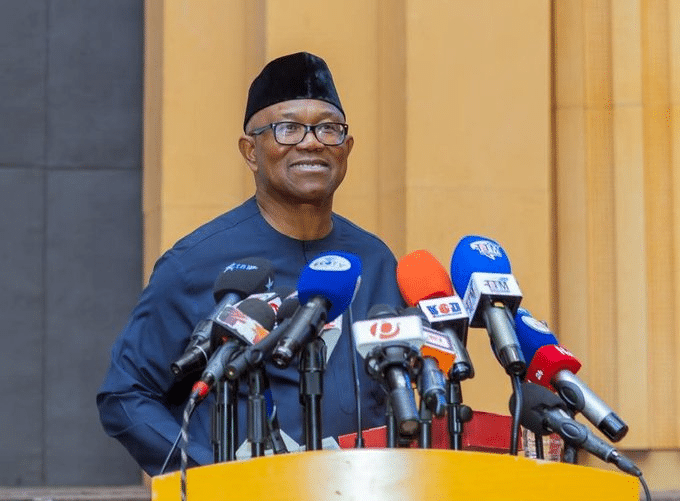
OBI VOWS CRACKDOWN ON “CRIMINALITY” IN FUEL SUBSIDY SYSTEM IF ELECTED PRESIDENT
Former Anambra State governor and 2023 presidential candidate Peter Obi has pledged a tough stance against what he describes as systemic abuse in Nigeria’s fuel subsidy framework, saying he would not tolerate any form of criminality if elected President in 2027.
Speaking during an interview on Trust TV, Obi renewed his criticism of Nigeria’s subsidy system, describing it as deeply flawed and open to large-scale exploitation.
He argued that the figures often presented on national fuel consumption do not reflect reality, insisting that there is a significant gap between reported data and actual usage.
“Subsidy is organised crime and I won’t allow any form of criminality as the President of Nigeria,” he said.
At the heart of his argument is a concern about accountability, specifically, how government systems can be manipulated without proper verification or transparency.
Obi also attempted to illustrate his point by comparing Nigeria with countries like Pakistan, suggesting that despite similarities in population size and infrastructure, reported fuel consumption figures differ significantly.
His question was simple but pointed: if the numbers don’t add up, where is the difference going?
The issue of fuel subsidy has long been one of Nigeria’s most controversial economic policies. Over the years, it has been linked to corruption allegations, subsidy fraud claims, and repeated debates about sustainability.
During the 2023 Nigerian presidential election, Obi, alongside other major candidates, supported subsidy removal in principle, arguing that the system was financially unsustainable.
That position eventually aligned with the decision taken by President Bola Tinubu at his inauguration in 2023, when he announced the removal of fuel subsidy.
While the policy move was widely viewed as economically necessary by some analysts, it also triggered immediate consequences, sharp increases in fuel prices, rising transport costs, and widespread inflationary pressure on households.
For many Nigerians, the impact of that decision is still being felt in daily life.
But Obi’s recent comments shift the conversation slightly, from whether subsidy should exist, to how it has been managed over the years.
His argument suggests that beyond removal, there is a deeper need to investigate the structure itself, particularly the accuracy of consumption data and the systems that may enable financial leakages.
It’s a call for scrutiny, not just reform.
And it raises a broader question about governance: is policy change enough, or must the systems behind it also be fundamentally rebuilt?
As the political landscape begins to shift toward 2027, discussions like this are likely to intensify.
Because beyond campaign promises, voters are increasingly asking for something more basic, clarity, accountability, and proof that public resources are being managed in their interest.
For Obi, the message is straightforward: reform is not just about removing policies, but about eliminating the systems that allow abuse to exist in the first place.