


POLITICS
NIGERIA DEEPENS ENERGY COOPERATION WITH IEA THROUGH NEW JOINT WORK PROGRAMME
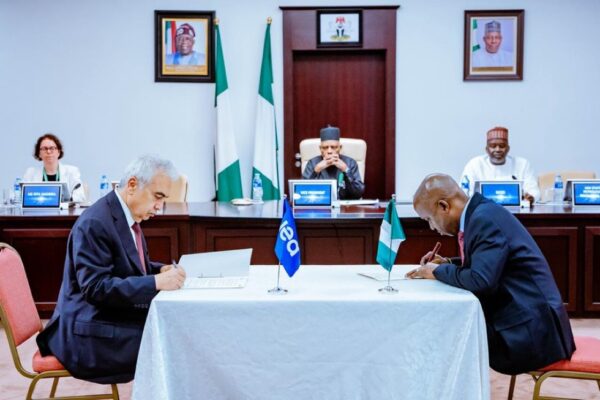
Nigeria has taken another step toward strengthening its position in the global energy sector after signing a Joint Work Programme with the International Energy Agency to expand cooperation on energy policy, investment, data development and energy security.
The agreement was signed in Abuja on Thursday, September 3, 2026, coinciding with Nigeria’s formal commencement of its partnership with the Paris-based organisation as an Association Country. The arrangement is expected to provide a structured platform for both sides to work together on key issues affecting Nigeria’s energy sector and its contribution to economic development.
Vice President Kashim Shettima, who represented President Bola Tinubu at the signing ceremony, described Nigeria’s admission as an Association Country as an important milestone. He said the development demonstrated Nigeria’s growing relevance within the international energy landscape and reflected confidence in the country’s commitment to energy cooperation.
Shettima also linked the partnership to the Federal Government’s economic reforms, arguing that Nigeria’s entry into the IEA would give the country an opportunity to make greater use of its extensive energy resources while benefiting from international expertise and cooperation.
Under the new Joint Work Programme, technical experts from the IEA will work with Nigerian institutions on the development of reliable energy data and policy frameworks. The collaboration will cover the energy value chain, with the broader objective of supporting economic growth, attracting investment and improving the country’s energy security.
IEA Executive Director Fatih Birol said the organisation would support Nigeria’s energy sector over the coming years through technical assistance and policy advice. He indicated that the cooperation would cover areas ranging from clean cooking and gas markets to capacity building and the training of Nigerian experts.
Birol said Nigeria’s admission as an Association Country was unanimously approved by the IEA board, which includes representatives of the United States, Japan, Germany, Italy and the United Kingdom. He expressed confidence that the partnership could contribute to a stronger and more sustainable energy future for the country.
Minister of State for Petroleum Resources (Gas), Ekperikpe Ekpo, said Nigeria’s admission was connected to the reforms undertaken by the Tinubu administration. He described the Joint Work Programme as an opportunity to deepen technical cooperation and improve the quality of information available for energy-sector policymaking and investment decisions.
The Minister of State for Foreign Affairs, Ambassador Sola Enikanoaiye, also described the partnership as strategically important to Nigeria. He said the Nigerian mission in Paris played an important role in facilitating the country’s successful engagement with the IEA.
Enikanoaiye said the Ministry of Foreign Affairs would continue to support the partnership by helping coordinate efforts and ensuring that the benefits of the agreement are aligned with Nigeria’s national interests and ultimately serve the Nigerian people.
The Director-General of the Energy Commission of Nigeria, Dr Mustapha Abdullahi, recalled that the commission had previously worked with the IEA, including through the joint sponsorship of Nigeria’s most recent National Energy Master Plan. However, he noted that the relationship had not previously operated under a formal structure.
Abdullahi expressed optimism that Nigeria’s new status and the Joint Work Programme would provide a stronger foundation for cooperation between the Energy Commission and the IEA, particularly in areas requiring technical expertise, energy planning and policy development.
The agreement comes as Nigeria continues efforts to attract investment, strengthen energy security and improve the policy environment surrounding its oil, gas and wider energy sectors. The government is expected to use the new relationship to access international expertise while developing policies and data systems capable of supporting long-term energy-sector growth.