


NATIONAL SECURITY
DHQ SAYS US TROOP DRAWDOWN WON’T END NIGERIA’S COUNTER-TERRORISM PARTNERSHIP
The Defence Headquarters has clarified that the planned withdrawal of about 200 United States military personnel deployed to Nigeria does not represent an end to the security partnership between Abuja and Washington.
The clarification was given by the Director of Defence Information, Major-General Samaila Uba, during a briefing involving spokespersons of various security agencies at the National Counter-Terrorism Centre, Office of the National Security Adviser, in Abuja.
According to Uba, the withdrawal is part of the evolving nature of the engagement between Nigeria and the United States, with the deployment of American personnel having been tied to specific operational and counter-terrorism objectives. He stressed that the adjustment in the number of U.S. troops should not be interpreted as a breakdown in bilateral security cooperation.
Uba said important components of the partnership would remain active, particularly in the areas of intelligence cooperation, military training, information sharing and technical assistance. He explained that the collaboration was designed primarily to strengthen the capabilities of Nigerian security forces rather than replace their responsibility for defending the country.
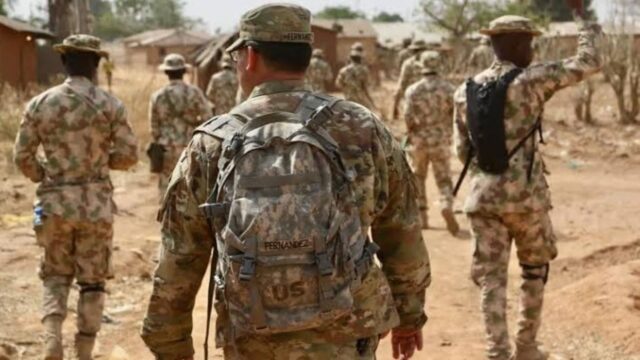
The main contingent of U.S. military personnel deployed earlier in 2026 to support counter-terrorism operations in northeastern Nigeria is expected to leave the country by the end of September. The troops had been involved in intelligence sharing, targeting support and training connected to efforts against militant groups operating around the Lake Chad Basin.
However, their departure will not mean a complete end to the American military presence in Nigeria. A smaller team of U.S. personnel is expected to remain behind, particularly to provide advisory and intelligence support as both countries continue their security cooperation.
The DHQ said joint action could still take place where Nigerian and American authorities jointly determine that additional operational measures are necessary. Uba noted that the partnership could include further cooperation, including joint strikes, when such operations are considered necessary by both sides.
He added that the continued relationship between Nigeria and the United States was aimed at improving the capacity of Nigerian forces through intelligence, training, technical support and other forms of professional military cooperation.
The planned drawdown had generated public interest and speculation over whether the United States was reducing its commitment to Nigeria's fight against terrorism. The DHQ's clarification was therefore intended to reassure Nigerians that the withdrawal of the larger contingent should not be viewed as the collapse of the security relationship.
The American personnel had been deployed to Nigeria earlier this year as part of intensified counter-terrorism cooperation, with their activities focused particularly on intelligence gathering, training and operational support in the northeast. The broader U.S.-Nigeria relationship has also included cooperation against terrorist organisations and other security threats affecting the region.
Meanwhile, the briefing also touched on a separate security incident in Kano State, where bandits reportedly killed an Almajiri and abducted the Chairman of the All Progressives Congress in Rogo Local Council Area, Abdullahi Beli.
Beli was reportedly kidnapped from his residence during an overnight attack on his Beli Village near Zarewa town. The state APC Publicity Secretary, Auwalu Sojo, confirmed the incident and said security agencies had been deployed in an effort to locate and rescue the abducted party chieftain.
The DHQ's position is that Nigeria's security responsibilities remain firmly with its own armed forces, while international partnerships such as the one with the United States are intended to enhance the country's ability to confront terrorism and other transnational threats.
The planned withdrawal of the larger U.S. contingent therefore marks a change in the structure of the deployment rather than an end to military cooperation between the two countries. Intelligence sharing, training, technical assistance and other areas of collaboration are expected to continue as Nigeria maintains its counter-terrorism operations.