


NATIONAL NEWS
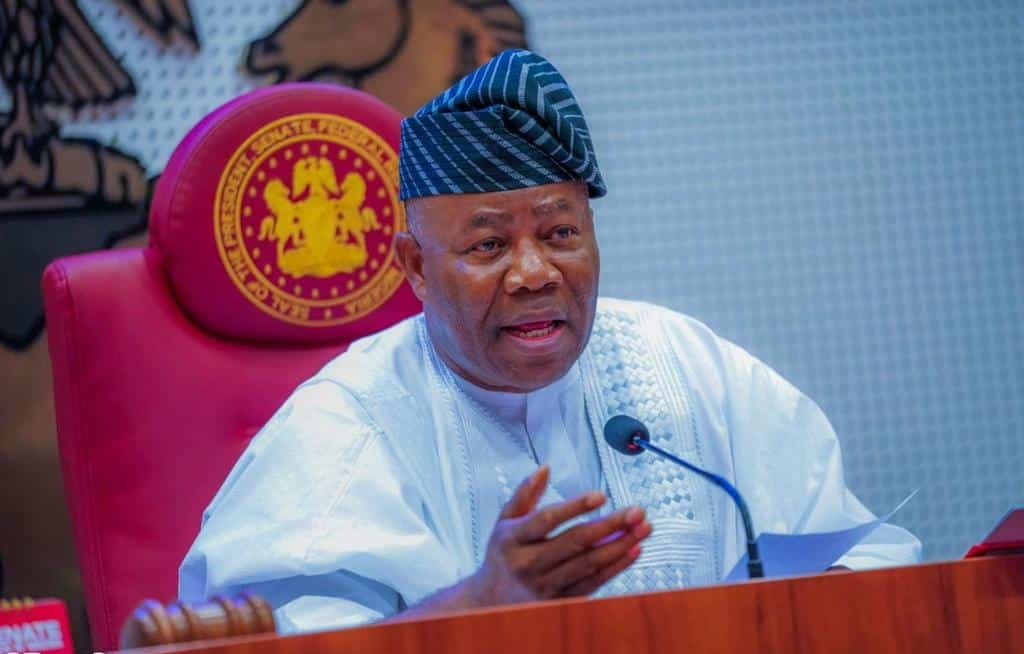
2026 BUDGET: AKPABIO DEFENDS EXECUTIVE–LEGISLATIVE COLLABORATION
President of the Senate, Senator Godswill Akpabio, on Friday defended the continued collaboration between the 10th National Assembly and the Executive arm of government, stressing that such cooperation is vital for national development.
Akpabio made the remarks during a joint sitting of the National Assembly at the presentation of the 2026 Appropriation Bill by President Bola Ahmed Tinubu.
In his welcome address, the Senate President responded to critics who have described the cordial relationship between the legislature and the executive as a “sell-out” by parliament. He dismissed the criticism, arguing that history repeatedly demonstrates that nations make the greatest progress when both arms of government work together in pursuit of the national interest.
Drawing on global examples, Akpabio referenced the United States under President Franklin D. Roosevelt, where close cooperation between Congress and the Executive during the New Deal era helped stabilize the economy amid the Great Depression. He also cited post-war Britain, noting how collaboration between Parliament and the government of Prime Minister Clement Attlee led to national reconstruction and the establishment of the National Health Service.
“In each instance, progress did not arise from uniformity of opinion, but from institutional cooperation rooted in a shared national purpose,” Akpabio said, adding that great nations are built when leaders take difficult decisions collectively, rather than waiting for perfect conditions.
He warned that persistent conflict between the executive and legislature often results in stagnation, citing the decline of the Roman Republic, where power struggles crippled governance, and repeated budget-related shutdowns in the United States that disrupted public services and slowed economic activity.
“Across history and continents, the lesson is consistent: when state institutions see each other as adversaries, the nation bears the cost; but when they operate as partners within constitutional bounds, stability is strengthened, reforms take hold, and progress becomes achievable,” he said.
Akpabio noted that it was within this framework of constitutional partnership that critical national decisions—such as the annual budget—derive both meaning and momentum.
He said the 10th Senate had, within the past year, recorded one of the highest levels of legislative productivity in Nigeria’s history, passing a record number of bills covering security, economic reform, governance, judicial administration, electoral integrity, infrastructure, and social protection.
According to him, several of these laws have significantly reshaped Nigeria’s reform architecture. He highlighted security-sector legislation that enhanced coordination among agencies, strengthened intelligence sharing, and reinforced the legal framework for combating terrorism, banditry, and transnational crime.
Akpabio also pointed to major economic and fiscal reforms that provided statutory backing for subsidy rationalization, public finance discipline, revenue mobilization, and improved accountability in the management of national resources.
On governance and justice, he said landmark laws had modernized court administration, improved access to justice, reduced procedural delays, and strengthened the independence and efficiency of democratic institutions. Electoral reforms, he added, were enacted to deepen transparency and restore public confidence in the democratic process.
He further noted that transformative laws in infrastructure, energy, and social protection had laid the legal foundation for accelerated capital development, power-sector reform, housing delivery, and targeted support for vulnerable Nigerians.
“Taken together, these laws have gone beyond expanding the statute books. They have translated reform intent into enforceable policy, stabilized governance, and provided the legal framework for national recovery and long-term prosperity,” he said.
However, Akpabio acknowledged that legislative progress must translate into tangible improvements in citizens’ lives, noting that many Nigerians continue to face rising living costs, unemployment, and insecurity.
He emphasized that insecurity-related deaths are not viewed as abstract statistics by lawmakers but as personal losses to their constituents, reaffirming the National Assembly’s commitment to strengthening legal and budgetary support for security agencies while enhancing oversight and accountability.
The Senate President called on Nigerians to continue supporting the administration of President Tinubu, assuring that the 10th National Assembly remains committed to serving the nation with diligence, responsibility, and resolve.